

The short answer: AI-referred shoppers are now the most valuable visitors on U.S. retail websites. According to Adobe Digital Insights, shoppers who clicked through to a retail site from an AI assistant in September 2026 generated 83% more revenue per visit and converted at a 90% higher rate than shoppers from every other channel. AI traffic to retail sites grew 71% year over year, is up 1,772% since October 2024, and Adobe expects it to jump 159% on Thanksgiving compared with last year.
For two years, the debate in our industry was whether AI search would ever send real traffic. That debate is over. The new question is much more interesting, and much more profitable: AI is sending the best traffic you get.
Here is what Adobe’s latest numbers show, why AI shoppers behave so differently, the catch inside Google’s AI Mode, and the exact moves we are making for clients before Thanksgiving.
Key takeaways
- AI-referred visitors converted 90% better and produced 83% more revenue per visit than non-AI visitors in September 2026.
- They also spent 73% more time on site and added products to their carts at a 53% higher rate.
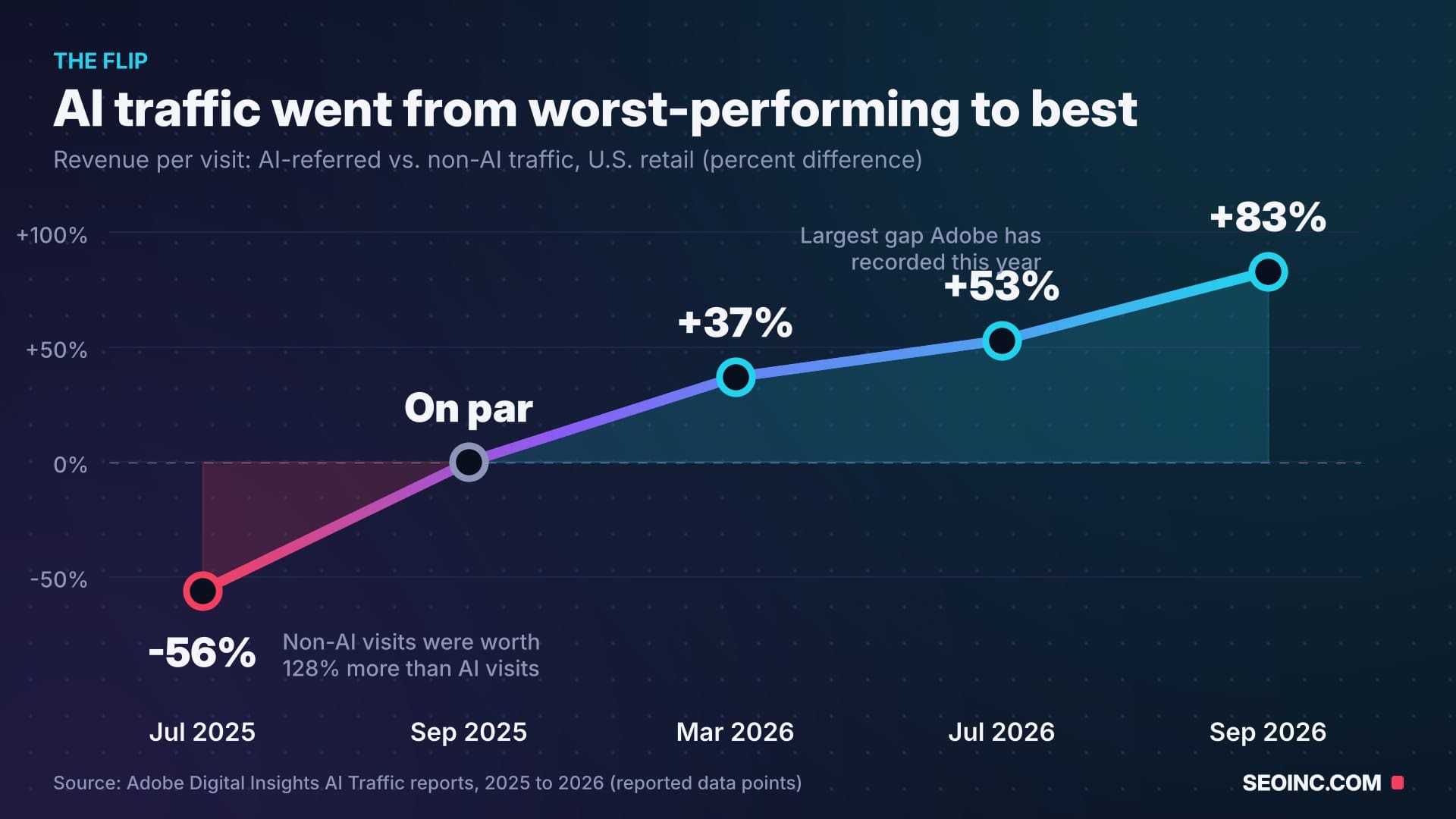
- Just over a year ago, AI traffic was the weakest channel. Today it is the strongest, and the gap keeps widening.
- Adobe forecasts AI traffic to retail sites will grow 130% this holiday season, peaking on Thanksgiving (+159%).
- Google’s AI Mode links only to Google’s own pages in 46.5% of product answers, so Google and the other AI assistants need different strategies.
The numbers: AI shoppers outperform every other channel
Adobe Digital Insights tracks more than one trillion visits to U.S. retail sites, which makes its AI Traffic report one of the most reliable views of how AI is changing online shopping. Adobe counts a visit as AI traffic when a shopper clicks a link inside an AI chat or AI browser service and lands on a retailer’s site.
In September 2026, those visitors beat non-AI visitors on every metric that matters to revenue:
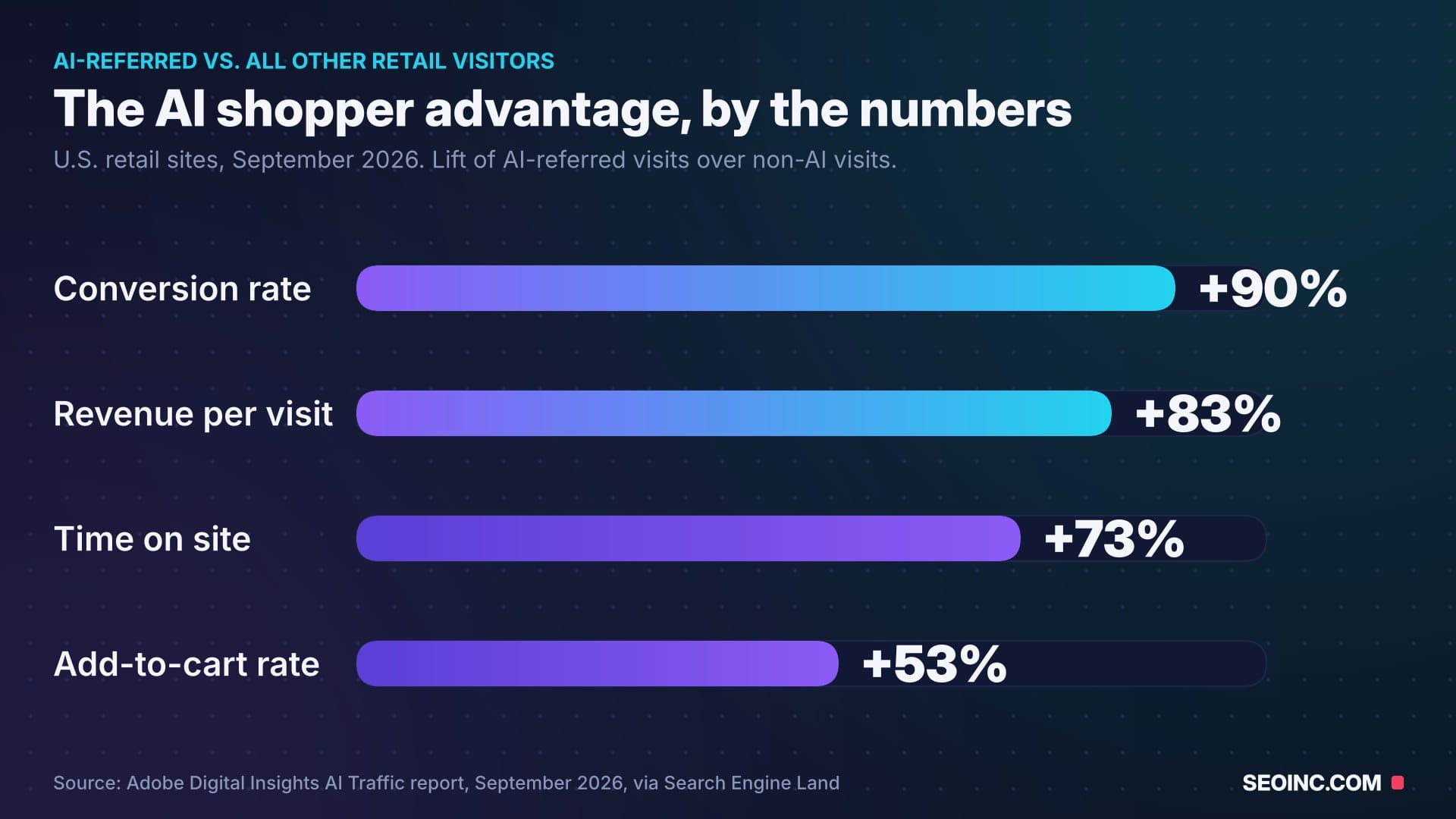
Adobe says the 83% revenue-per-visit premium is the largest gap it has measured this year. In plain business terms, every AI-referred visit is worth almost two regular visits. If your AI referrals are flat while competitors’ are growing, you are not just losing traffic. You are losing your highest-value buyers.
From worst channel to best in about a year
What makes this data remarkable is the speed of the turnaround. In July 2025, non-AI visitors were worth 128% more per visit than AI visitors. By September 2025, the two were roughly even. Twelve months later, AI visitors are worth 83% more.
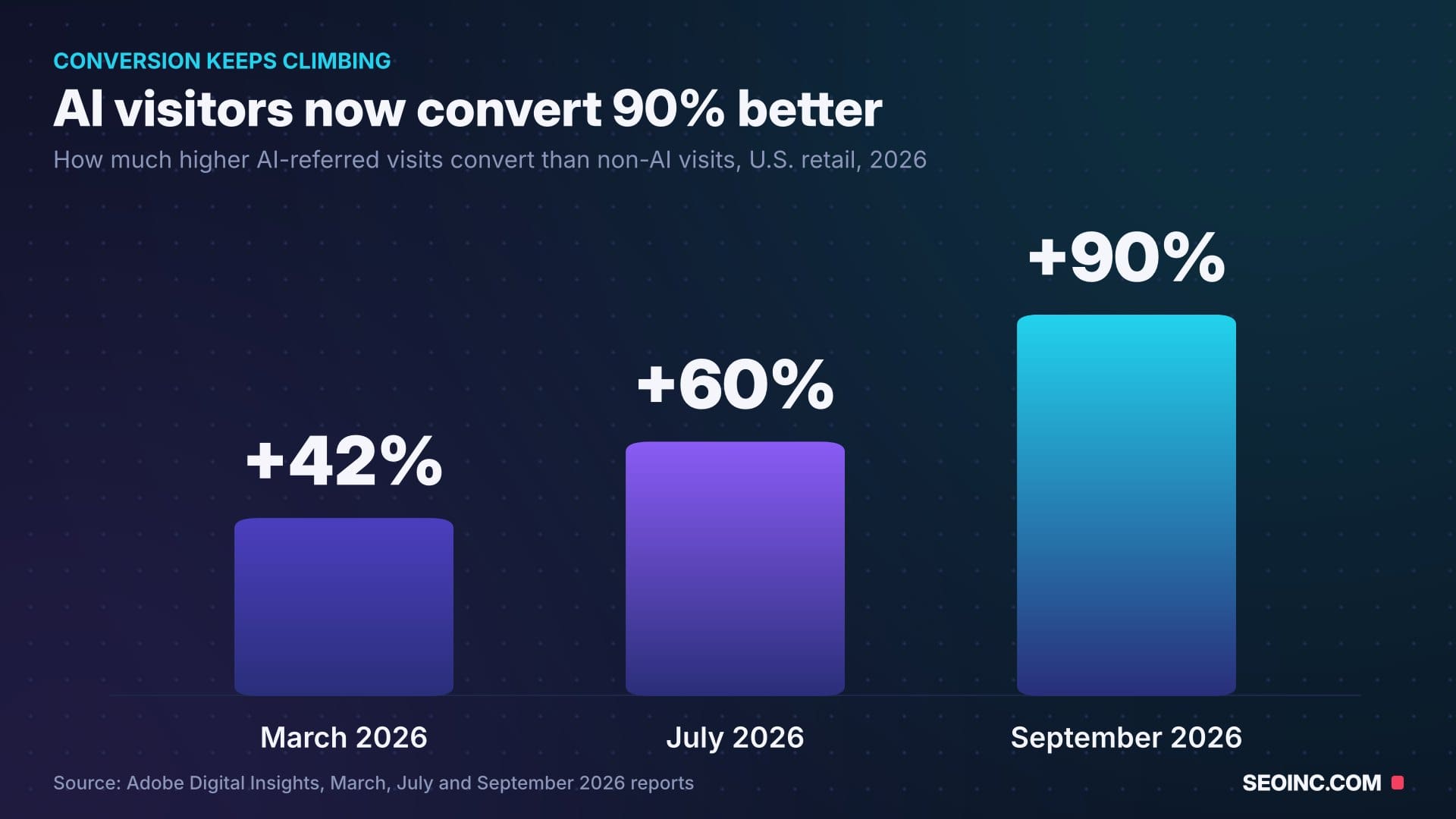
Conversion rates tell the same story. AI visitors converted 42% better in March 2026, 60% better in July, and 90% better by September. That is not a blip. It is a trend line pointing straight up.
Why AI-referred shoppers are worth so much more
After nearly 30 years of watching search behavior change, from GoTo and Overture to Google Shopping to AI assistants, the pattern here is familiar. The value of a click depends on how much of the buying decision happened before the click. AI assistants move almost the entire decision upstream.
- The research happens in the chat. Shoppers ask an assistant to compare options, read reviews, and narrow a shortlist. By the time they click, they have already decided.
- The click is a vote of confidence. When an assistant recommends your product or page, it acts like a trusted referral. The visitor arrives already believing you are a good fit.
- Fewer clicks, better clicks. AI answers satisfy casual curiosity without a visit. The people who do click are the ones ready to act.
- They validate, then buy. The 73% longer time on site and 53% higher add-to-cart rate show AI visitors are checking specs, pricing, and shipping on their way to checkout, not bouncing.
This is the core reason AI visibility is now a revenue strategy, not a branding exercise. Showing up in the answer means showing up at the moment of decision.
AI traffic is still early, and that is the opportunity
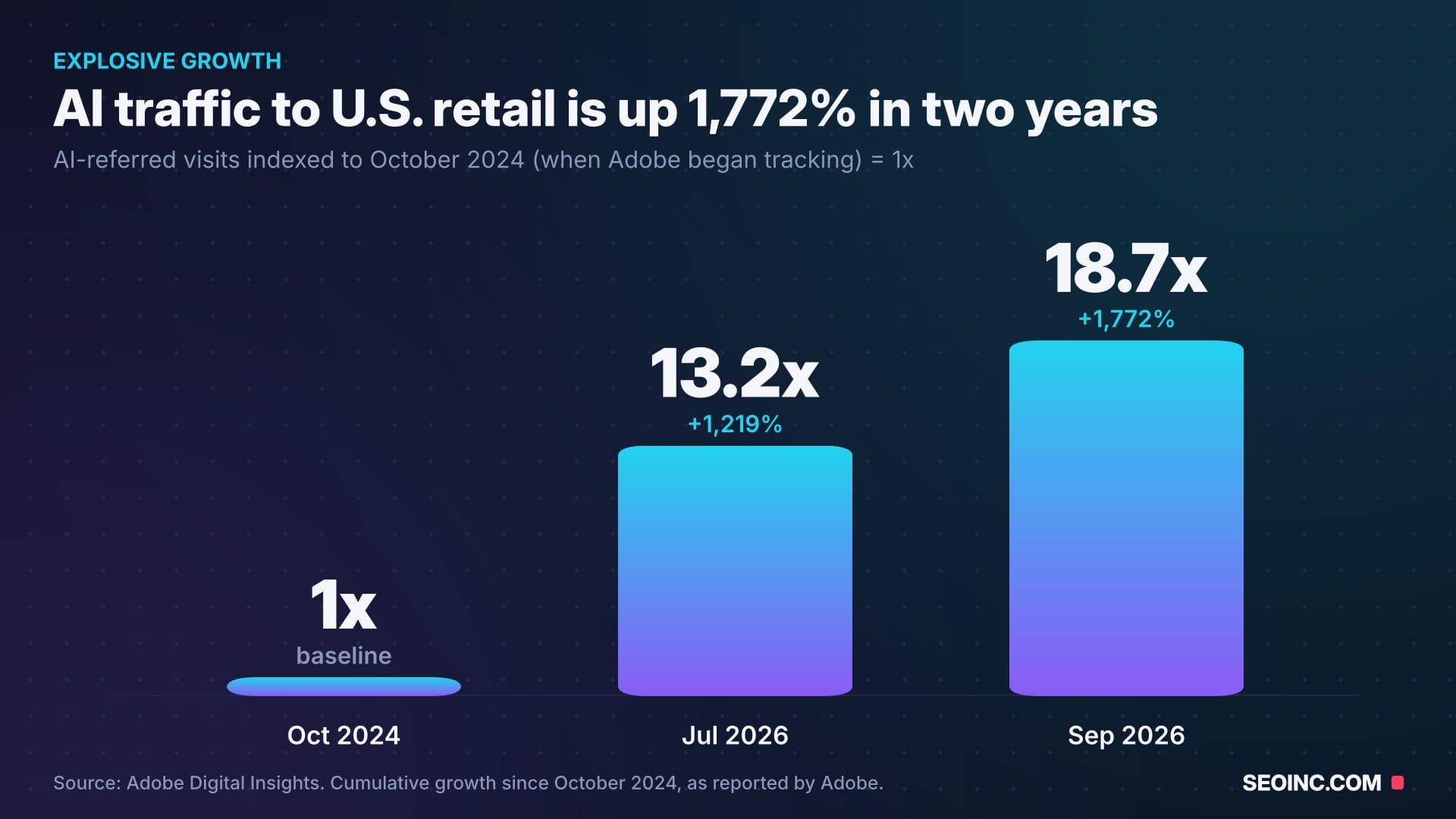
AI referrals have grown about 18.7 times since Adobe started tracking them in October 2024. Even so, AI is still a smaller share of total retail traffic than search, email, or social, and Adobe has not published an exact share. That combination of small share and outsized value is exactly where the best returns live. The brands that build AI visibility now will own the default recommendations when AI shopping becomes mainstream.
Holiday 2026: Thanksgiving is the big AI shopping day
Adobe forecasts record U.S. online holiday spending of $275.1 billion from November 1 through December 31, up 6.7% year over year. Cyber Monday (November 30) is expected to be the biggest single day at $15.1 billion, followed by Black Friday at $12.9 billion. Cyber Week as a whole should bring in $47.5 billion.
AI traffic is expected to grow much faster than spending overall:
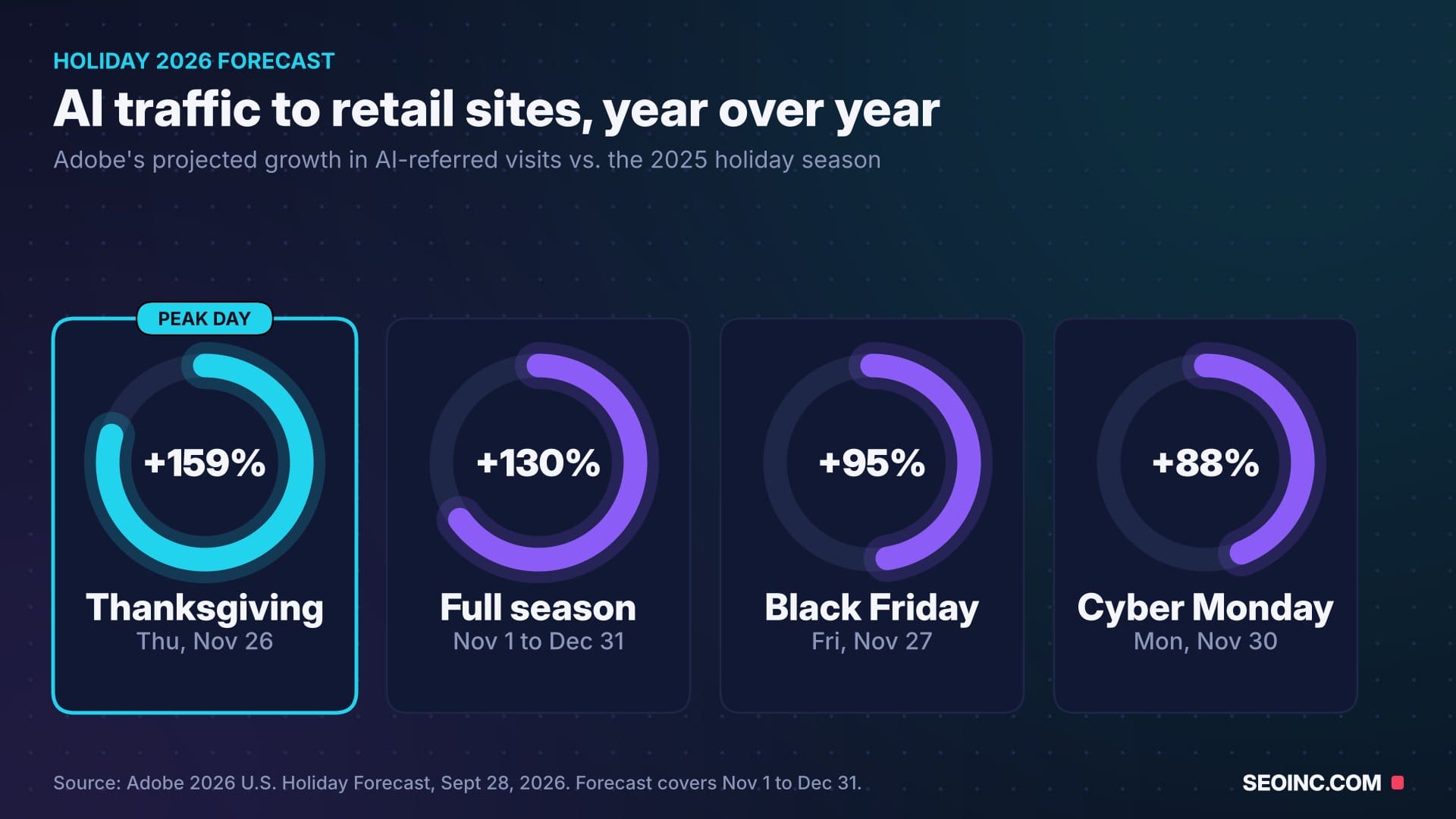
Our read on the Thanksgiving spike: it is a research day. Shoppers are on the couch with their phones, asking AI assistants which TV, laptop, or gift to buy before the Black Friday deals go live. If your products and pages are not in those answers on Thanksgiving, you may not get a second chance on Black Friday. Keep in mind these are forecasts, and Adobe’s actual numbers will land after the season ends.
The catch: Google’s AI Mode wants to keep the click
Not every AI surface sends traffic the same way. A new Findrix study of 55,198 AI-generated product answers, reported by Search Engine Land, found that Google’s AI Mode linked only to Google’s own pages in 46.5% of U.S. product answers, and that 57% of all product links in AI Mode pointed to Google Shopping pages. Fashion and beauty categories were the most Google-contained.
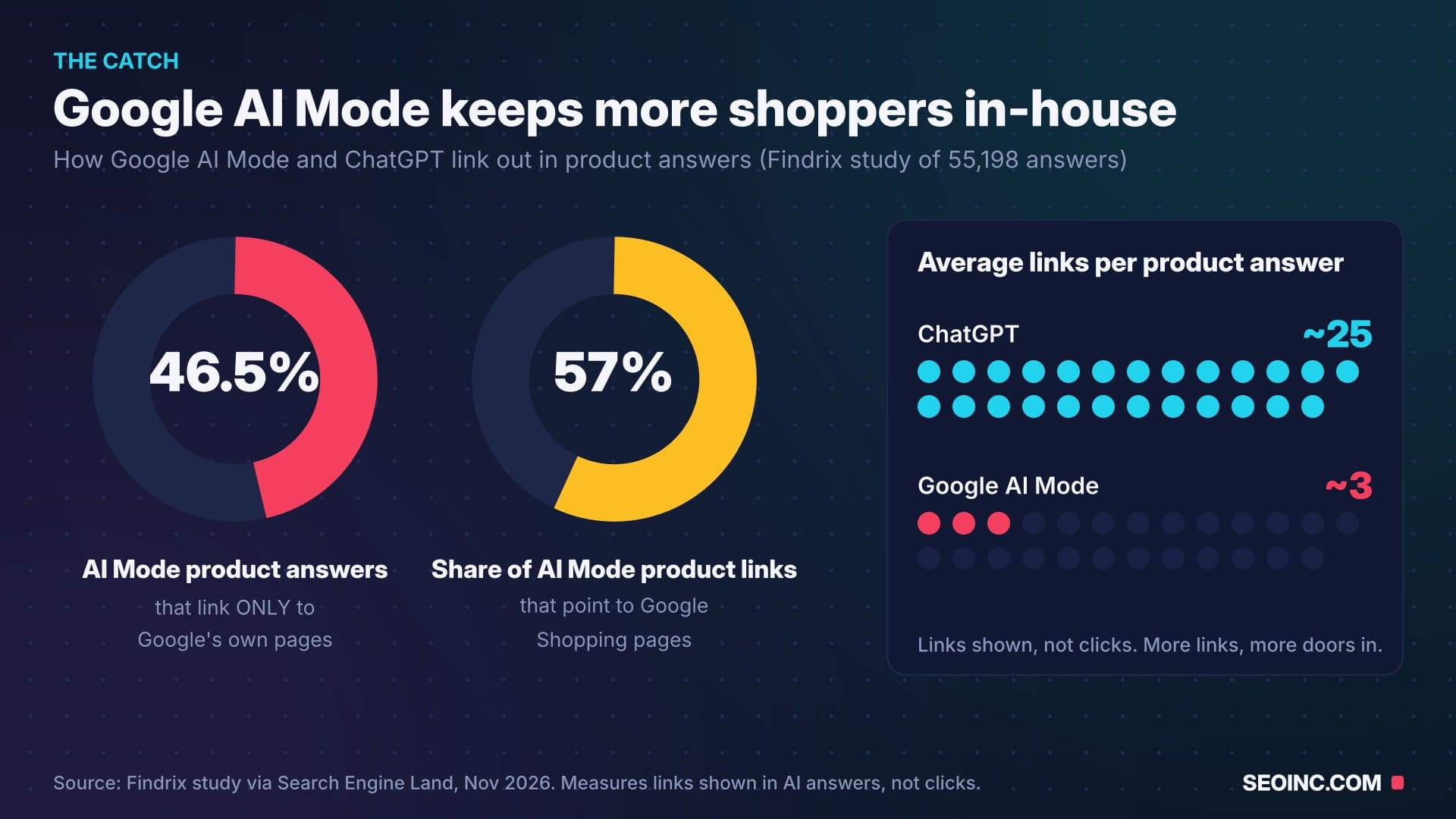
ChatGPT behaved very differently, with roughly 25 links per answer compared with about three for AI Mode. Separate research from Productrise found AI Mode showed products on only about 23% of shopping queries, compared with about 88% for standard Google search. Google itself just told investors that AI Mode’s lower monetization slowed Search ad revenue growth in Q3, even though Search revenue still grew 12% to $63.3 billion.
The takeaway is simple: you need two strategies. Inside Google, your Merchant Center product data is your storefront, because AI Mode builds answers from Google’s Shopping Graph. Outside Google, in ChatGPT, Perplexity, Gemini, and Copilot, your content, reviews, and third-party mentions decide whether you get cited and clicked.
The SEO Inc. playbook: 6 moves to make before Thanksgiving
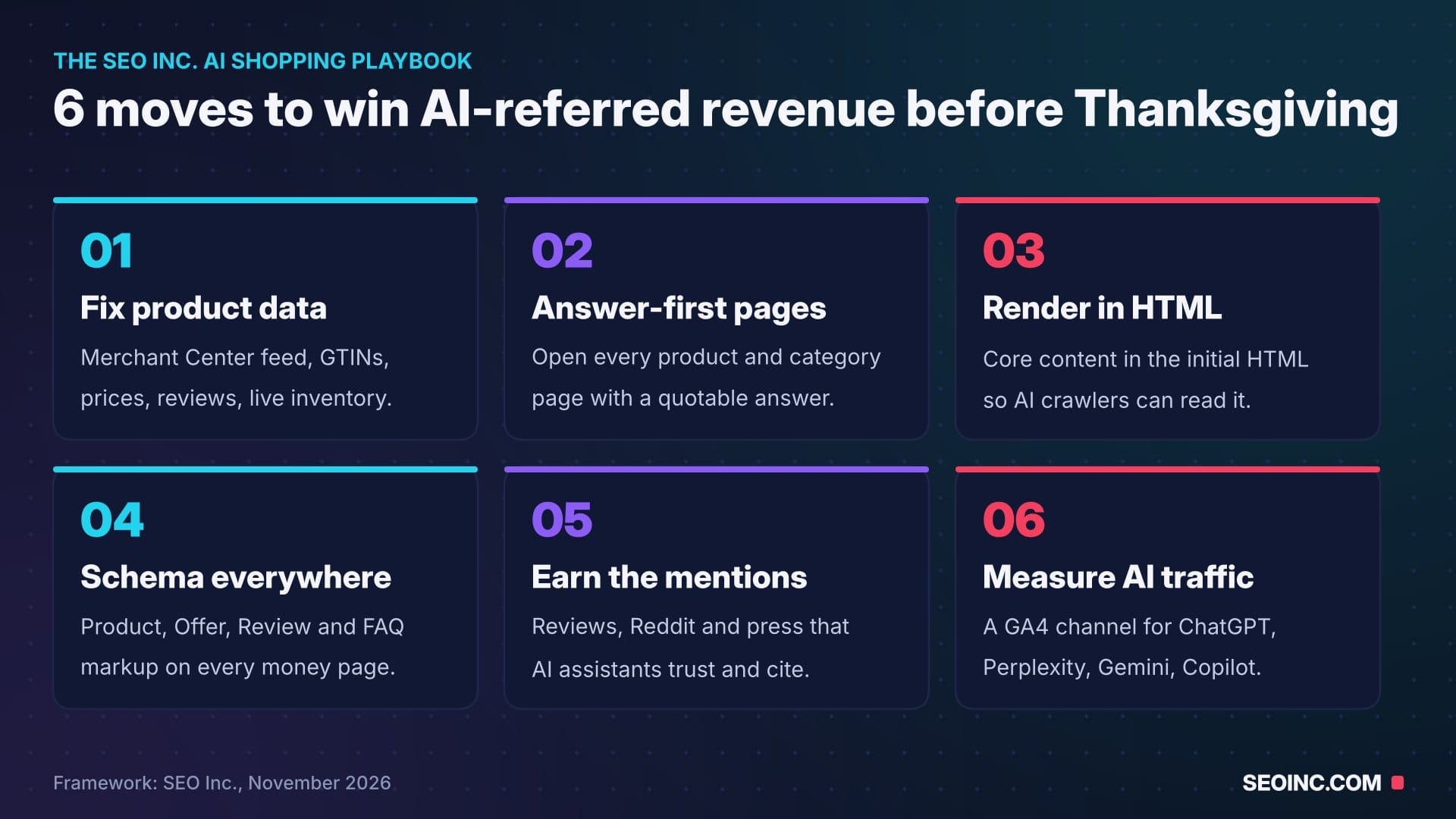
1. Fix your product data first
Clean up your Google Merchant Center feed: accurate GTINs, current prices, in-stock status, shipping details, and review ratings. AI Mode and Google Shopping pull from the same product data, so feed errors now cost you visibility in both.
2. Write answer-first product and category pages
Open every money page with a clear, two to three sentence answer to the question a shopper would ask an AI assistant: who the product is for, what makes it different, and the key spec or price point. AI systems quote content that answers cleanly.
3. Put critical content in the initial HTML
Many AI crawlers do not execute JavaScript. If your product descriptions, specs, prices, or reviews only load through JavaScript, those crawlers may never see them. Make sure the content that sells is in the page source on first load.
4. Add structured data to every money page
Use Product, Offer, AggregateRating, Review, and FAQPage schema so AI systems can read your prices, availability, and ratings without guessing. Pair it with Organization and Person schema to strengthen trust signals.
5. Earn the mentions AI assistants trust
AI assistants lean heavily on third-party sources when they recommend products: review sites, comparison articles, press coverage, and Reddit discussions. A steady flow of genuine reviews and authentic community presence is now a direct input into AI recommendations.
6. Measure AI traffic separately in GA4
You cannot improve what you do not track. In GA4, create a custom channel group called AI Assistants with a rule that matches the session source against this regex:
.*(chatgpt\.com|chat\.openai\.com|perplexity\.ai|gemini\.google\.com|copilot\.microsoft\.com|claude\.ai|meta\.ai).*Place the AI Assistants channel above Referral in the channel order so these sessions are not lumped in with ordinary referral traffic. One caveat: clicks from Google’s AI Overviews and AI Mode are reported as Google organic traffic, so they will not appear in this channel. For the full setup, see our guide on how to measure AI search traffic.
Bonus: Get into the conversation with ChatGPT Ads
Organic AI visibility takes time to build. ChatGPT Ads put your brand inside relevant ChatGPT conversations now, right when shoppers are comparing options. SEO Inc. now manages ChatGPT Ads alongside Google paid search, so you can cover the holiday window on both fronts while your organic AI visibility grows. Here is what to know about the latest ChatGPT Ads expansion.
Not a retailer? This still applies to you
Adobe’s data comes from retail, but the behavior behind it is not unique to shopping carts. Anywhere a buyer researches before acting, whether they are choosing a dentist, a locksmith, a contractor, or a software vendor, more of that research now happens inside AI assistants. The businesses that get named in those answers receive visitors who are further along and more ready to act. For a lead generation business, that means fewer, better leads and a shorter path to revenue.
Frequently asked questions
What is AI-referred traffic?
AI-referred traffic is any visit that arrives when a user clicks a link inside an AI assistant or AI browser, such as ChatGPT, Perplexity, Gemini, or Copilot. Adobe measures it as shoppers clicking a link from an AI chat or browser service to a retail site.
How much more do AI shoppers spend?
In September 2026, AI-referred visitors to U.S. retail sites generated 83% more revenue per visit and converted at a 90% higher rate than non-AI visitors, according to Adobe Digital Insights.
How much will AI traffic grow during the 2026 holidays?
Adobe forecasts AI traffic to U.S. retail sites will grow 130% year over year for the season, with the biggest jumps on Thanksgiving (159%), Black Friday (95%), and Cyber Monday (88%).
Does Google AI Mode send traffic to retailers?
Less than other assistants. A Findrix study found AI Mode linked only to Google’s own pages in 46.5% of U.S. product answers, and 57% of its product links went to Google Shopping. ChatGPT included about 25 links per answer compared with about three in AI Mode.
How do I track AI traffic in Google Analytics 4?
Create a custom channel group in GA4 that matches session sources such as chatgpt.com, perplexity.ai, gemini.google.com, and copilot.microsoft.com, and place it above Referral. Traffic from Google AI Overviews and AI Mode will still show as Google organic.
How do I get my products recommended by ChatGPT?
Keep product data accurate, write answer-first pages, put key content in the initial HTML, add Product and Review schema, and earn genuine reviews and third-party mentions. For immediate visibility, ChatGPT Ads can place your brand in relevant conversations while organic AI visibility builds.
Is AI sending you its best buyers, or sending them to your competitors?
SEO Inc. focuses on three things: leads, revenue, and AI visibility. Our AI Visibility Audit shows where your brand appears in ChatGPT, Perplexity, Gemini, and Google AI Mode today, what your AI referrals are worth, and the fastest fixes before the holiday rush. We combine SEO, Google paid search, ChatGPT Ads, and Reddit into one plan built around results, not hours.
About the author
Garry Grant is the founder and CEO of SEO Inc., which he started in 1997. He has worked online since 1993, was an early adopter of paid search in the GoTo and Overture era, and built proprietary bid automation software. Garry holds Google’s Google Ads AI-Powered Performance certification and the Google Analytics certification, and he created the first college-accredited SEO and SEM course for the University of California, San Diego. His work has been featured in The New York Times, The Wall Street Journal, WIRED, and Entrepreneur.
Sources
- Adobe: AI traffic drives 83% higher revenue per visit for U.S. retailers
- Retail TouchPoints: Adobe AI traffic driving higher revenue per visit (Oct 29, 2026)
- Chain Store Age: Adobe AI e-commerce traffic soars in September
- Adobe 2026 U.S. Holiday Forecast press release (Sept 28, 2026)
- Adobe AI Traffic Trends report, August 2026
- Decrypt: AI traffic to U.S. retailers in Q1 2026
- Search Engine Land: Google AI Mode sends 57% of product links to Google Shopping
- PPC Land: AI Mode surfaced roughly 95% fewer product listings (Productrise)